
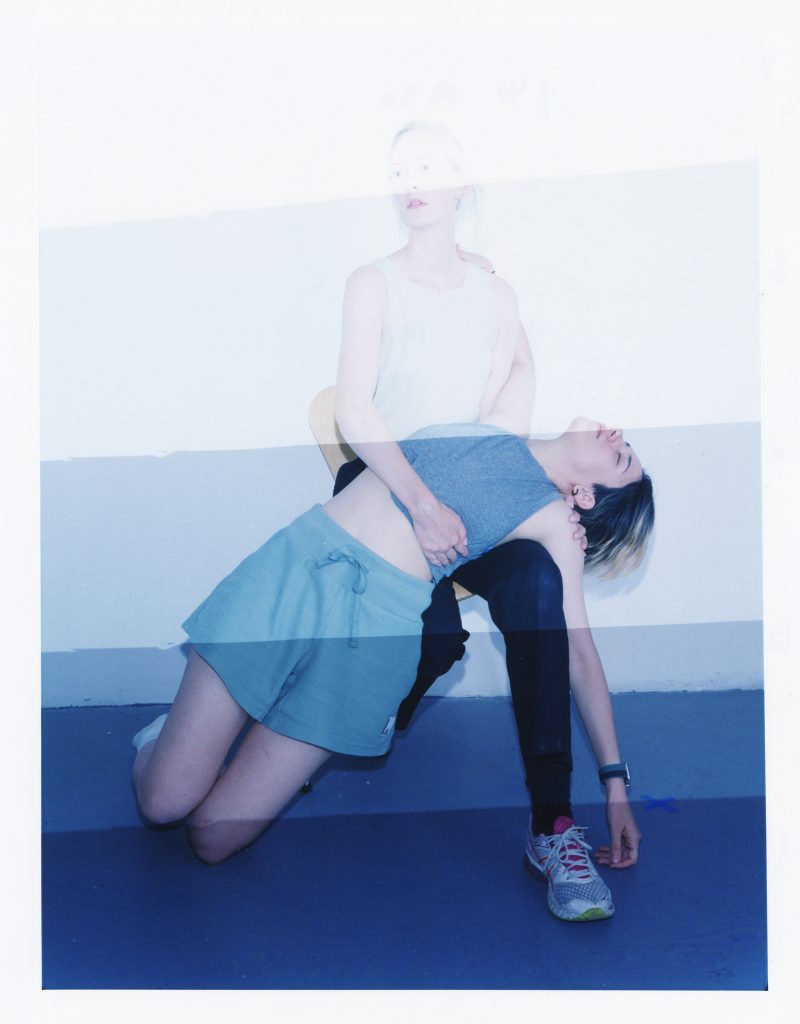
When you think you have seen the model-to-photographer genre wear itself thin, along comes Matilde SøesRasmussen to challenge, deepen, and extract gold from the topic by putting together her second intriguing photobook, which deals with modelling. Søes Rasmussen ’s first book, Unprofessional, published by Disko Bay, was a grand slam that, through her point-and-shoot aesthetic, detailed her ordeal as a model in China and its effects on her thinking about life, photography, and autonomy. Through interesting diaristic asides, the story of Unprofessional unfolded through narrative and her quite spectacular photography. I remain a massive fan of the book and was unsure, as I am with many young artists, where such a heavyweight of a first book will lead them down the road. Will it endeavor a sophomore slump or push their work into bold territories? Will there even be a second book? Will the book deviate from the first success, or will it languish, trapped in a cycle of repetition and stay locked into previous glory? These are questions that I frequently ask when encountering a second book from an artist.

In the case of Inspiration, published recently by XYZ Books in Portugal, I am happy to report that Matilde’s second book has defied all the problematic questions I have about artists’ follow-up books. It is fantastic and is an elevated discussion regarding some of the concerns she began to outline in Unprofessional. It also keeps in line with her first book in that it is partially autobiographical, detailing Matilde’s three-month sojourn to New York on a quest to understand a subsequent biographical inquiry into the life of Aubrey Munson, the muse, model, and potentially even the world’s first super model whose life in New York, Matilde details through her investigations which lead her to public statues, whose countenance is based on Matilde. Munson, muse to artists and filmmakers, had a dramatic life.
Once a young model for sculptures that would end up at the 1915 Panama–Pacific International Exposition, Munson’s later life would end in tragedy when she was mistakenly confused as an accomplice to a murder. This event led to the quick cancellation of her career. Within a short time, her mother had her committed to an insane asylum, where she spent most of her 104 years on earth (living on the same timeline as Matilde, if for a short spell). Barring a late family intervention and a series of visits, the model’s stories and history would have remained unclaimed were it not for the care of her extended family, who began visiting her at the end of her life and may have liberated her from the asylum, placing her in a care home. There are unconfirmed reports that her last days were spent in a rest home. Matilde has followed Munson’s story and added a layer of lost biography to it through her own work.
 What makes this book special, beyond its biography of Munson, is Matilde’s decision to examine her own work with models as a photographer and model and to think through the role she and others have played for photographers and artists in general terms. Through her dialogue in the book, she makes it clear that she understands the strange nature of dominion that photography and photographers have over their muses, and she questions, having been on both sides of the lens, what it means to continue the ritual of photography through her work. Employing modeling agencies, some of which she used to work for (and allegedly still owes her money), Matilde sifts through headshots, ordering models to be photographed both in New York and later in Paris, creating a dialogue with her models, but also Munson, examining the act of photography and what it entails.
What is excellent is seeing Matilde’s progress in her photography over the intervening years since Unprofessional. Her work has become elevated. Her use of fragments is exceptionally alluring, and that she incorporates the statues of (maybe) Munson along New York’s municipal façade is particularly of note. Her work feels more considered, with less of the “throwaway” point-and-shoot aesthetic found in the first book. She has put in much more technical skill, and the photographs reflect this considered approach. Instead of feeling like the images are an extension of Jurgen Teller’s approach to photography, I’m reminded of Collier Schorr or Felipe Beltran Romano, with sterile yet minimal rooms where she photographs her subjects.

The use of the fragments and the chapterized biography of Munson, along with Matilde’s own autobiography, makes for an interesting crossover from literature to photography itself. I am reminded a little bit of Annie Ernaux’s work between the mediums, or perhaps Sophie Calle to an extent. I really hope she continues adding to the text, as I believe it gives the work the edge needed to clarify her ongoing interests in modeling and autobiography. I wasn’t quite sure what to expect from her follow-up book. Still, I might suggest that it is a powerful second book, and that, as remarkable as Unprofessional was, there is something much more considered and thought-through in Inspiration. Can there be a third book about this topic? It is hard to say. One apparent thing, though, is that it will be hard to top the second offering. Highest Recommendation!