

She’s posing for consumer products now and thenFor every camera, she gives the best she canI think I saw her on the cover of a magazineNow she’s a big success, I want to meet her again
-Kraftwerk, via Big Black
Of course, I know nothing about modelling. Still, I can assume that there is a heavy emphasis on discipline, and the breakdown of character to create a persona, an entity that is neither person nor actor, but something in between. Someone who can sell the dream of beauty, who can relate to us non-personas a type of lifestyle bordering on celebrity, who can, in their ideal form, illuminate the world with their teeth, their smile, their bodies. We appreciate beauty. We appreciate the Adonis, the chiseled jawlines, and we understand the prom queen, as much as our desires will allow us to look. What to do with it all is a question I am not sure has been fully answered. This is not judgment, this is inquiry. I am fascinated by obsession, obsessed even.

The world of pageants and beauty queen showcases has been studied for some time. The current President of America could tell you about it. The late Prime Minister Berlusconi could bunga bunga his way through it. If you ask any average citizen about it, they might tell you about a Chilean death-metal princess crowned in a diadem of light. Or perhaps they could tell you about the never-ending search for JonBenét Ramsey’s killer (s). What obsession we can relate to the world of pageantry often has an undertone of salacious morbidity attached to it, and we are all well aware of this. Of course, to look at the spectacle of it all more benignly, we might ultimately decide that beauty is a valued pursuit and that in pursuing it, we are exemplifying the physical attributes of our species, as we do with bodybuilding. Perhaps, in reality, what these pageants allow us to do is express desire communally, in the case of beauty, and maybe a little horror when it comes to bodybuilding. Both are spectacles of an orgy of types. Typologies of desire. A casual stone flung into the pond of everlasting youth and peak physicality.

Is beauty a gift or a burden? The mental calculus needed to divulge its secrets fully, its plot lines to decide an outcome, is… hermetic, at best. I personally have no innate knowledge of beauty, its structures, or economies enough to participate in such matters. All said, I find the curious world of exhibitionism often crosses my path in photography. Jürgen Teller’s Go-Sees was one of the first books that I bought. I wasn’t even sure why I bought it when it came out, or shortly thereafter, but it has travelled with me to several countries. It has always been on a shelf, and I think of it, along with a slightly later book called Tracht that he made, as being incredible insight into the industry of modelling, and it, along with a few other projects like Nurnburg, are reasons that I continually back his work. However, he remains contentious to a degree in the world of photography at present.

In more recent times, Matilde Søes Rasmussen’s Unprofessional and her new book Inspiration look at the culture of modelling from the inside out, and her work centers on her personal experience as an artist navigating the world of modelling. Of course, mentioning Corinne Day’s archive would be of interest here, as she was able to show the industry’s backside through her connections as a model and with Kate Moss. The model-to-photographer pipeline is very real. I think of Viviane Sassen’s work in this context, as well as Lina Scheynius, Sarah Moon, Ellen von Unworth, and Helena Christensen, who have all pursued this pipeline.

What appeals to me about Carla Rossi’s new book, Bellissima, published by the eminent Belgian publisher Art Paper Editions (APE), is its ability to stretch our notion of what the world of pageantry involves. Much of this stems from her relationship with Rebecca, the model featured in the book. There is a collaborative feel to the work, in which Rebecca navigates how her image is perceived in the context of these pageants and how her relationship with Rossi further shapes it.
Rossi becomes part of the work by letting Rebecca take some control over her appearance and, in particular, by sharing ideas about how she wants to be photographed in the studio. This provides for a rich exchange and a playful mood in the non-runway images. I am reminded of stills from Antonioni’s Blow-up, of course, as well as the studio work of Barbara Probst and Paul Mpagi Sepuya. There is an interesting game at play with the cameras and tripods, in which Rebecca navigates them differently than she walks the runway. You begin to see the person behind the persona, the real Rebecca steps forward, as it were.

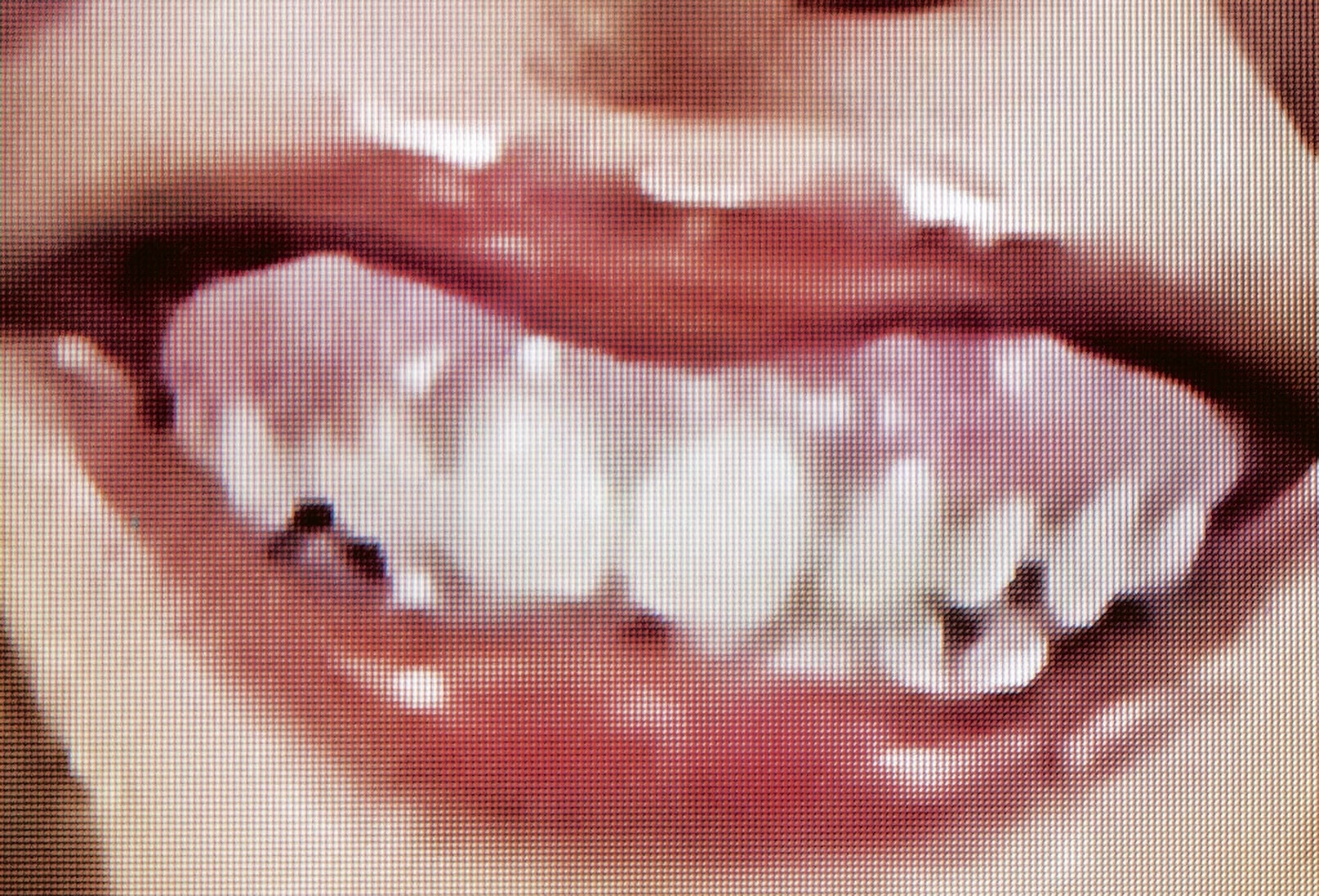
In terms of the book object itself, it brings me back to one of my early loves in photobook publishing: the publisher Scalo, whom I bang on about at every opportunity, as I very much miss the energy of those books in the contemporary medium of the photobook. I recently found some of this energy in the work of Mara Palena, Jason Hendardy, and Gareth McConnell, and I find it sadly missing in photography as a whole. However, publishers like APE and ROMA, amongst others, are still shaking things up a bit (without the overdesign of other publishers killing some potential). Some of this Scalo energy in Carla’s work comes from her use of grainy video stills and the dissolution of the image, which brings about a strange somnambulist state of viewing.
The images translate, but often in a fog of noise, which adds to the meta-narrative being crafted about observation and the pageant industry. It feels real, but it also feels like fragments from a dream. It is familiar, but, despite its reality, we are instead asked to equivocate on our understanding of that world through Rossi’s saturated, stretched images. The result is a kind of image pandemonium, where we do not understand where we are as spectators of art, of a social construct, of a forming irreality, and in that lies the power of the book, along with the smart, if minimal, design. Rossi’s ability to capture both worlds of Rebecca’s person and person is commendable. The volume of images doesn’t let up, and I love that it feels like an extended project rather than just a passing experience. Great work is fashioned from duration, often. Bellissima is executed with thought, concern, but also a chameleon-like ability to shift images from their commercial or documentary feel into something anxious and unruly. A remarkable parallel book for this would be the recent Roma Publications book More by Blommers and Schumm.
This is one of several fantastic books APE has published this year. Titles from Eoin Moylan, Lisa Dennison, Lucile Boiron, and Donna Trope (under the Monogram name) are pushing boundaries and keeping things fresh, pushing the limits of sex, fashion, and art. And many of these titles, of this persuasion, are from Women. Keep that in mind. This has been a consistent motif of APE, even under the past decades’ duress of outrage porn. You have to respect the output and the ethos. I look forward to seeing what Rossi does next and will keep a continued eye on the APE catalog.