
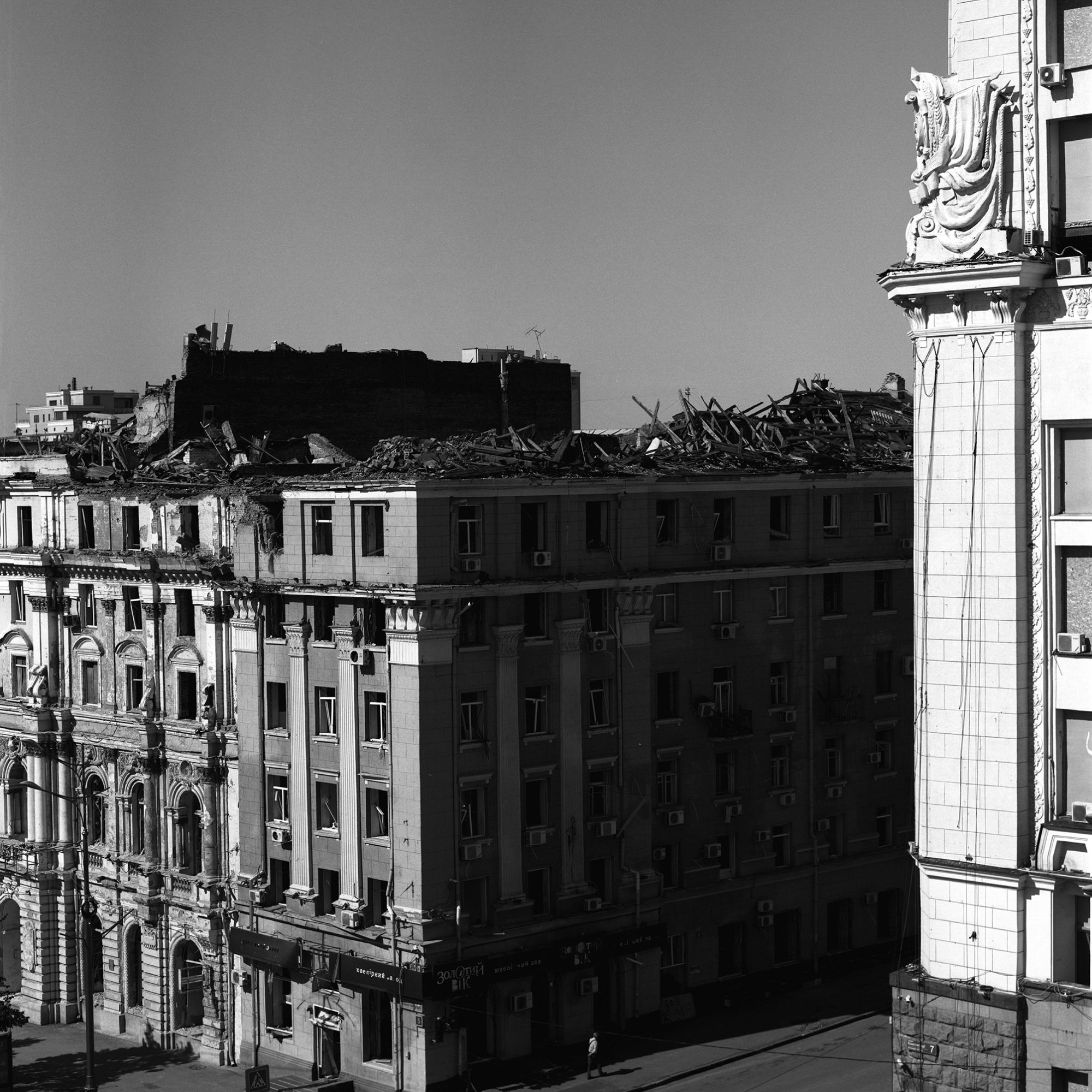
I do not know much about the war in Ukraine, despite living in a country that borders it. I don’t know much about it as the fog of war hangs heavily, like a thick, void-like curtain over the whole mess. The principal idea is clear. Russia has invaded its neighbor and, in doing so, has violated international borders and treaties. It has done so, and here is where it becomes conjecture already, under the pretense of NATO expansionism and encroaching militaristic interests in the region, predominantly funded or licensed by the war hawks in America and the multi-national corporations that stand to benefit, as in Gaza, from the complete razing of a country and the demoralization and slaughter of its people. Arguments will be had over these last lines.

I have found myself attacked in public forums for suggesting some of what I have above by Ukrainians, who disagree or believe that I am not knowledgeable on the subject, which, as here, in agreement, I have previously declared there. It seems there is no easy way to talk about the subject without triggering some ire. Again, this is understandable, so I have started writing this review, which is only a review, as I have. It is a tense subject for obvious reasons. I will try to avoid arguing my points with someone living in the region, as it is their right to discuss things from their position under duress. However, I do not hesitate to say cauterizing another opinion or observation will not keep the discussion moving. Having the debate, however embittered, keeps the struggle alive. Berating someone, especially someone sympathetic, is not serving anyone. I am someone who reviews photobooks, not an analyst.

With this stated, I will continue my journey through Yana Kononova’s book Radiations of War (XYZ Books and Fotofok). , I am not apologetic, I do understand and sympathize with the brutality people are experiencing in Ukraine, and also the ethnic cleansing of Gaza, and under no circumstances condone war of any kind. It almost seems trite to speak about such matters through photography, photobooks, and art, as if it is an abstraction while continuing to discuss real-world suffering and abuse. This sentiment lies at the crux of photography, of course, its inability to adequately describe what is in front of its lens or even the intention of its authorship.

And with that disclaimer set in motion, I will mention my other hesitation in writing about Yana’s work. The principal hesitation, second to criticism by online anger bots, is that I am unsure how to interpret the work as it reflects an ongoing phenomenon. The scale of the war, the displacement, and the butchery are very hard to contextualize or make meaning of through pictures. I guess this is where the general distrust of narratives or the problem of authority has led us. I do not read the material in Yana’s book as news exactly. Whereas it does echo photojournalism and war photography in the manner of Gilles Peress, Gerda Taro, Gabriela Basilico, and Robert Capa, amongst others, it has other melancholic tendencies which treat the hollowed-out landscape of war as sculptural at times. I consider this a way the documentary ties to the work are limited by the pursuit of the subjective, and I find it incredibly compelling. I am torn between understanding the dark and murky realm of the photographs from the active theater of war they represent. It creates a schism of understanding. Do I read these photographs like Lewis Baltz, Raymond Meeks, or emphasize their ruinous sublime? Or, should I treat them as a document, an examination of war photography in process? Both would be the answer I would proffer. Is thinking of Yana’s work through the lens of art a conflict in itself?

This has led me to think about how fast photobooks can be created and how we must understand history and violence as they are ongoing. Of course, photobooks were produced during conflict during the 20th Century, during the Second World War, and the Vietnam and Bosnian wars. It is not a new moment for publishing. Still, I am experiencing it differently than previous generations with the Internet and the possibility for such tomes to be produced during the conflict and distributed before the war ends. This leads me to question whether any work published during the midst of a war or political event can be anything but biased, especially if the person making the work is from the land under siege. This is not to accuse anybody of propaganda but to understand and discern how to read work like this, primarily through what I can only signal as Photography Now, perhaps indirectly a looming exhibition title concerning reel/real time war reporting in the 21st Century. Conrad, but certainly Coppola might approve. This suggests that there are no longer codes of representation that can be accurately described as documentary.

This is also not a news flash, but a specific way to suggest that picture-making is a complex arrangement of values, content, and subjective experience, primarily as extremes are concerned. It is tough to be embedded on both sides of a war, is it not? In this, categorically, is a one-sided perspective that can only be co-aligned with another body of work from the other side, often conflating the entirety of any attempt at unilateral positioning. I am hinting that it is tough to read work during an event and parse it out. Further complicating matters, it is not easy at the level of the post-event to unfurl many of these same positions, leaving remarkable questions about how to handle photography at all in this capacity. I have no real or imagined solutions to make the context of war photography plausible to parse from either side of a conflict or from either side of the timeline. What I do know is that the medium’s claim toward subjectivity relates much more to the empathy I am triggered by than the incredulous notion of fact-changing or fact-checking, for that matter.

To explain my thoughts on Radiations of War outside of the general complications of reception and iterations of meaning, I would have to imply why I think this book is essential, though some of my thoughts will reflect an oblique approach to the book on aesthetic levels over that of the political. This does not demean the subject matter within. Still, as stated in the beginning, it is a challenging conversation without offending anyone by invoking elements of design, picture-making, and form. I do not want to dissociate the notion of the horror within it. It is not my intent, but as outlined, understanding the political situation from afar and from one point of view will also have its limits. I find it hard to talk about editing and sequencing, or what I might be at odds with in the (slight over) design, without it all feeling negligible, as if the points I might raise about the technical procedures of the book could, by any comparison, reflect its subject matter.
In Yana’s work, I am drawn to one difficult element I am trying to reconcile as I write this: how can pictures of such unmitigated terror be found as beautiful as they are? With this now on the plate, I presume it is easy to understand how I struggle with the work outside of the primary layer of conflict that it represents. In Yana’s photographs, I find an ethereal beauty in the ruinous emancipation of her images. To suggest there is beauty to the horror of it all is, in my mind at least, to display the human condition out loud. It suggests parallel ways human thought can understand two polar ideas and reconcile them in the middle through emotional response. I feel that Yana’s photographs are sublime, and I also appreciate their horror. It creates a chaos of response, which I might argue says as much about me as it does about the artist’s ability to evoke, through visual means, an experience from the viewer that resonates from the subject matter of suffering.

Throughout the book, I am presented twisted metal, rebar, concrete, and bodies contorted to suggest catastrophe and decimation. I am held in awe of the obliterated, though I feel guilty for this entanglement of appreciation, given the severity of the war itself. This governs what is and is not imaginable in how we receive such pictures. Can I imagine standing before wreckage, watching the sun draw on the facade of amissile-laced apartment complex, or the sheer olfactory challenge and suck of bodies being pulled from the ground waiting to be reclaimed. I am reminded of other books and photographs. I am reminded of Olive Edis’s pictures of the devastation of WWI, and I am reminded further, in light, shadow, and decimation of Martien Coppen’s seminal post-event WWII photobook Impressies 1945. These images, like those of Hiroshima and Nagasaki, fail to tell the story, but they provide a condition to consider, observe, and calculate from.

It is all perfectly hallucinatory and again I am reminded of that strange atmosphere, most brilliantly conveyed in Apocalypse Now, where nothing is real, where the trippy endorphin mix of human perceptions being challenged by violence in their environment signals a chemical response in the brain which suggests an exercise in alienation, of world-building gone wrong. I am present and I am locked-in at the same time with a paralysis that compresses at the back of my neck, my only salvation when in this fugue state is that I have the privilege to shut the book. And yet, I keep looking at monstrous sculpture, mortal and dear remains, with astonishment, head bent, heart squeezed. I react. I flail.

Radiations of War is an incredibly powerful book that, in its observational edict, is a pertinent reminder of the world we are not living in when we look at it. We view it from the comfort of our homes, our book fairs, and our little song-and-dance award ceremonies, not without concern, but certainly from a distance, and in this lies the utter corruptibility of our viewing, that we are spectators in a theater of death, destruction, and disembodied knowledge. Whereas I have never believed a book or a series of photographs can change the course of the world, it can serve, in re/e/a/l time a reminder of the barbarity in which we are capable, the severe maligned order of the human condition and the encroaching darkness that continues to fall across lands both foreign and domestic. We are nearly powerless in the shadows, the monumental urge to resist being our only bulwark against the imperiled polite side of the human argument. Observation is resistance. Resistance is power. Power is accumulated agency and it is a big Go Fuck Yourself in the age of discontinuity. So far, this is the most vital book of the year, no matter how I look at it.

Yana Kononova
Radiations of War
Fotodok/XYZ Books