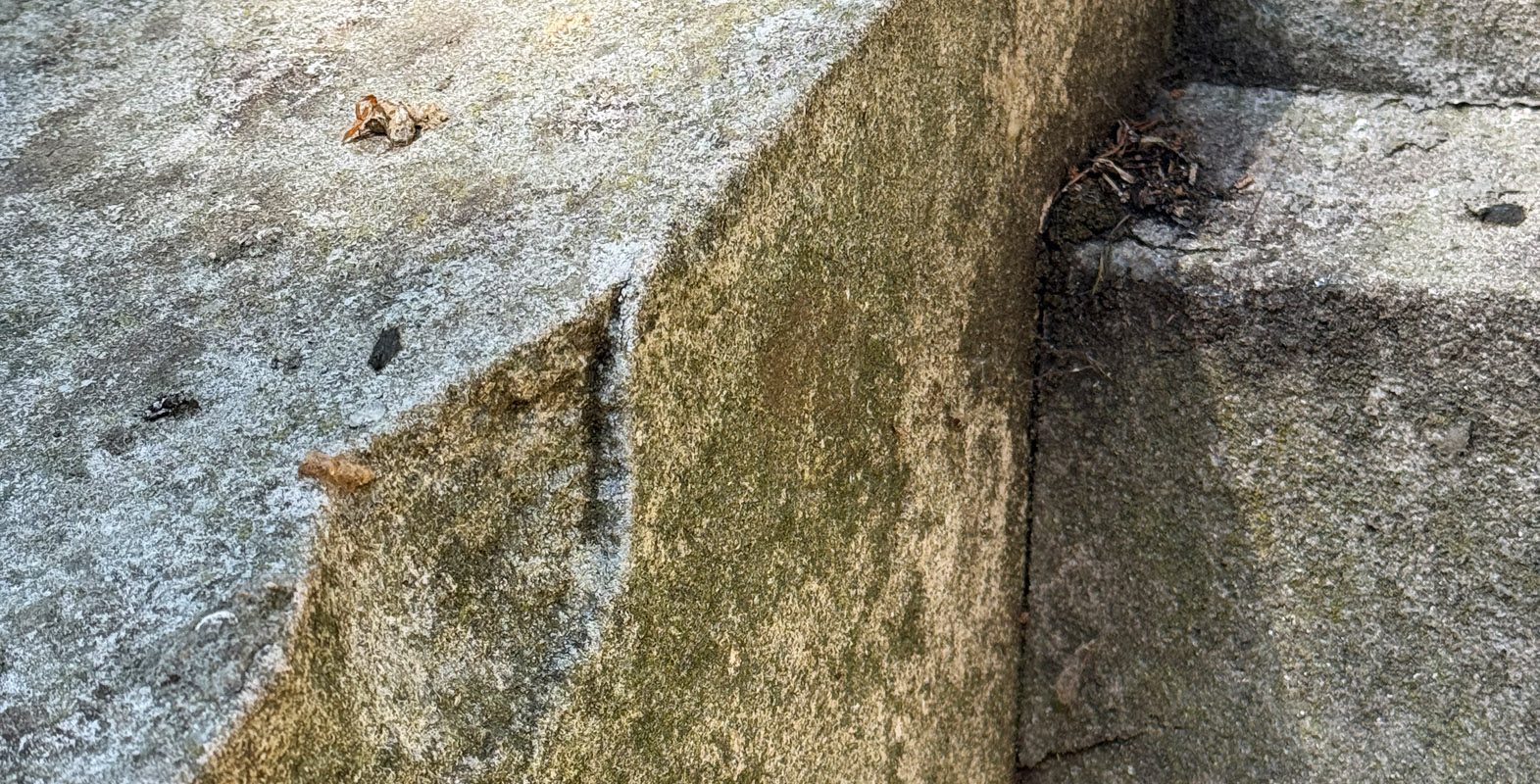

Sometimes, all it takes is a corner and a series of evaporating shadows to serve as a conduit to greater understanding of the built environment and all the human activity that has transpired within it. In studying Charles Johnstone’s court photography, what is exceptionally evident is the simplicity with which the rendering of space provides detail for artful observation. Striking a balance between the objective elements of architecture, in this case, the handball five-finger court at High Elms in Eton, England, and the expressive delineation of line and form, Johnstone has found a way to communicate the spatial dimensions of the High Elms handball court through an expressive means of subjective observation, more in line with the work of Eugène Atget than the travails of purposeful documentary trandition.

Johnstone is not trying to replicate a space for objective dissemination, but rather to curtail the viewer’s expectations regarding its ambience and essence. The essential nature of court architecture is tied up in its history and its echoes. In the case of the High Elms court, built in the 1860s, one can hear the fraternity and haunted reverberations in Johnstone’s photographs as voices seep from the photographs informing us that this plain-standing alleyway, where young men slapped a ball back and forth with a gloved series of hands, providing a historical imperative, of sport and leisure in Queen Victoria’s Britain. One of the few open-air, accessible Grade II-listed handball courts, the High Elms’ architecture looks quotidian, almost easily overlooked if not for those echoes. The modesty of its composition belies the function of its communal usage. An empty passage, a three-sided enclosure, and its facade, occasionally cast in shadow, are all the artist has to sculpt a sense of its history.

I am reminded, in Johnstone’s efforts to engage with Atget, as mentioned above, of an artist in late nineteenth- and early twentieth-century Paris who, through sheer lyrical determinism, rendered the everyday corners of the post-Haussmannization city into something deeply atmospheric. Every corner, wall, tree, and fence feels uplifted into a form that gives way to a deep, impenetrable feeling of place. Further attitudes towards Johnstone’s court work might also be best referenced in two discussions concerning the architectural supernatural. The first example I might cite is Lucien Hervé, the Hungarian photographer who worked with Le Corbusier as a painter of light of his architectural gestures. I have been careful with my language on this, as I, like Charles, do not see Lucien as simply a photographer but as a painter of spaces that I believe, in their rendering of shape and time, stone and mortar reveal something about the presence/essence of the facade that very few other photographers/artists can do. Perhaps it is best to cite Hervé’s own words…
‘No, I wasn’t thinking about collage, a practice I love, but which had nothing to do with this case; I was thinking more about the freedom and scrupulous rigour in construction that had to be present in each of my images. You see, unlike many photographers at the time, I had no respect for film itself. For most of them, film is almost sacred, the image that remains printed is definitive. I thought, on the contrary, and not only because I was a young photographer, that one had to be free in everything, whether it was a painting, a drawing, a collage or a photograph. […] In an image, the relationship between shapes and tones constitutes a composition. Each image must achieve, through the use of scissors or other means, something constructed, and I would also add a certain purity. I use scissors simply because they help to achieve this result.’
The two quotes are from Lucien Hervé and Hans Ulrich Obrist, Lucien Hervé (Paris, Manuella Éditions, 2011), 10–11, 15–16.

For further reference, I will also defer to one of the greatest artists alive today, Guido Guidi, whose catalog of architectural work, at its core, comprises some of the finest images of architectural edifices. Like Johnstone, Guidi finds a nearly spiritual, supernatural subject matter in architecture. The most significant example of this might be his photographs of Carlo Scarpa’s magnificent Brion Tomb, in which the artist challenges the very foundations of the architecture by dissecting it with strong lines, asking the viewer to understand the work through its use of sublime light rather than its material value. In rendering the architecture with strong shadows and lines, Guidi asks the viewer to examine the reality of its surface, as well as the environment in which it sits, and the experience of those who would walk its grounds. Without this tendency to cut lines, the Tomb itself would become a flat, immovable image, something that cauterizes dreams of what it might be like to haunt its edifice and grounds as a viewer, and the same penchant for these observed realities is evident in Charles’s use of similar light and cutting shadowline. Without this, and the occasional blue sky peeking through the vaulting of his photographs, we would be left with an unimaginable spatial reality, a form that asks us to abscond its value from our imagination into a simple “reading” of the facade.

Whereas this book offers an expanded appreciation of Johnstone’s work as it the space it outdoors, confined to three walls, with less obsrvable court features, it might be one of his most honest and succesful of the court projects as it asks us to understand the spatial rteality of the High Elms court by giving it form through available light, and providing features, via shadow, for its otherwise fairly non-descript edifice. In this sense, the architecture is illuminated more than it would otherwise be: an indoor court in which the play lines and the confines of encloised space leave little for the natural world to infiltrate the frame. Doing with less in this case has provided for a more relational understanding of the courts. Included is another enjoyable James Zug text on the history of the court, which continues the tradition of collaboration found in some of Charles’s other court works. In reviewing this, I reiterate that I am not a sports person, but I have become increasingly interested in the use of architectural space, so this book scratches a particular itch in my own relationship with photography, and I do not think I could ask for more than that.

Charles Johnstone
The Court at High Elms
Sun